
      | |
Perry
There are at least 120 perry pear varieties, many so local that they were only ever propagated on 1 or 2 adjacent farms. There are some great names including Dead Boy, Mumblehead and Merrylegs. Hellens, a fine old manor house in Much Marcle, open to visitors in the summer, has an avenue of Hellens Early planted about 1710 to commemorate the coronation of Queen Anne. Perry pears contain varying amounts of a natural sweetener called sorbitol which does not ferment to alcohol. Perry often has a touch of sweetness as a result. However, there is a side-effect. Sorbitol can have a laxative action. Some people are more susceptible than others. It is this property, that at its extreme, which has probably given rise to the saying �Perry goes down like velvet, round like thunder and out like lightning.� You have been warned. Perry ProductionPerry production is similar to cider but there are some key differences. Frequently perry pears should be milled immediately after they have been collected as they are difficult to keep once picked. This means more single variety perries. Shaking off the tree is frequently not an option due to the size and height of many perry pear trees. Also between milling and pressing the pomace is often allowed to rest for 24 hours which reduces the high level of tannins found in some perry pear varieties. All in all a drink that requires somewhat more attention to detail than cider and Herefordshire is lucky in having a number of specialist perry producers who are rediscovering and developing the craft of perry production. |
 Cider Producers
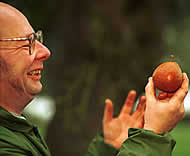 Although not as well known as cider, the making of perry from pears is traditional throughout the county, particularly around the Herefordshire-Gloucestershire border. Perry is produced in a similar way to cider, with perry pears replacing the apples, giving a distinctive taste. Perry pear trees can be seen in abundance across the eastern Herefordshire landscape with trees rising as high as 15 metres dwarfing nearby cider apples. Perry pears had their heyday in the late 17th and early 18th centuries - the tree will remain in good health and cropping for at least 300 years, more than twice the maximum life of the apple.